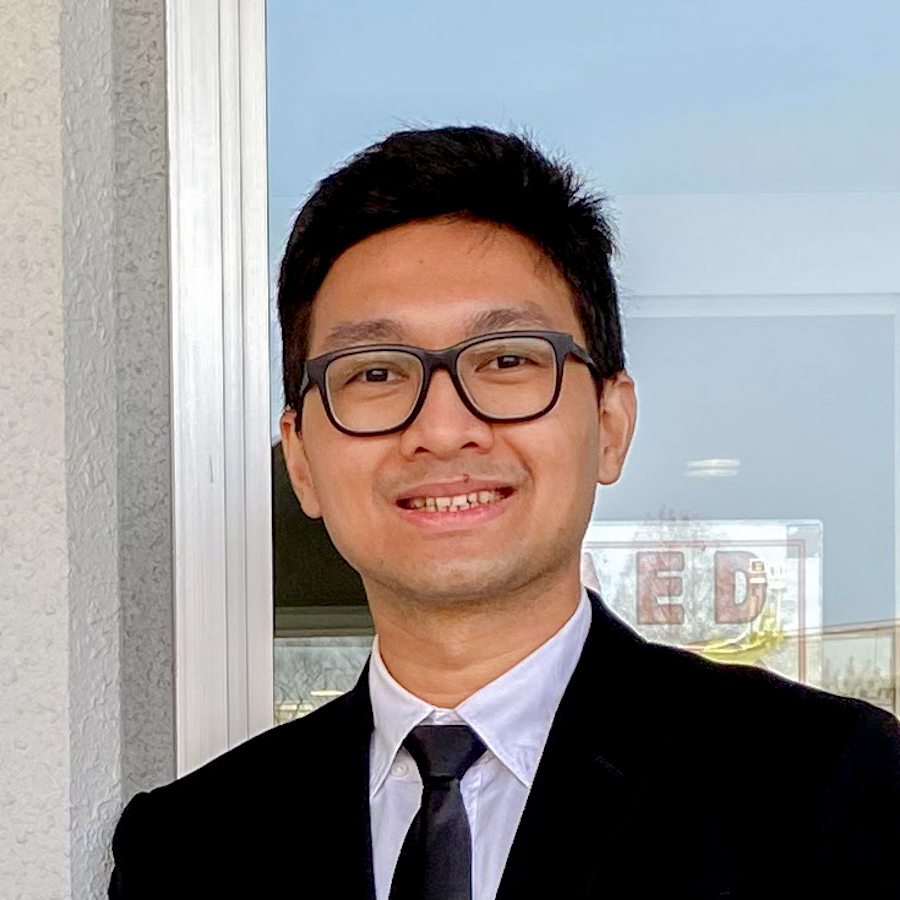
Yonatan Hutabarat
Biomechanics · Wearable Technology · Human Behavior · Digital Health
Bonn, Germany
I am an early-career researcher working at the intersection of biomechanics and motor neuroscience, aiming to advance our understanding of human movement from a neuromechanical perspective. I develop and apply experimental and computational methods to study movement in naturalistic settings using multimodal approaches, including gold-standard optical motion capture, wearable sensors, and musculoskeletal modeling. My long-term goal is to pioneer predictive models that not only explain healthy motor control but also forecast the onset of movement impairments, paving the way for personalized interventions and adaptive assistive technologies.
I have recently completed my four-year postdoctoral training at the Centre for AI and Neuroscience, University of Bonn under the guidance of Dominik Bach. Prior to this, I received my Doctor of Philosophy in Biomedical Engineering from Tohoku University in 2022, supervised by Mitsuhiro Hayashibe at the Neuro-robotics Lab. I received my Master of Science in Engineering and Technology in 2018 and Bachelor of Engineering in Engineering Physics in 2015, at SIIT Thammasat University and Universitas Gadjah Mada, respectively.
I am looking for opportunities to collaborate on research projects and contribute to the advancement of knowledge in the field of biomechanics and neuroscience and their practical and clinical applications. Please feel free to reach out if you are interested in working together!
Methodological & Scientific Contributions
Embodied human behavior in naturalistic immersive environment
UNIVERSITY OF BONN · 2022–2026When confronted with lethal threats, animals often display rapid, species-specific defensive behaviors. In contrast, human-specific defensive behaviors remain largely unknown and are challenging to investigate, partly due to ethical constraints in studying real life threat scenarios. In this project, we established a synchronized freely moving virtual reality (fm-VR) and motion-tracking system where participants forage in naturalistic environments while evading biologically relevant lethal threats. Across multi-site experiments, we identify a dominant human escape sequence: initial head turn toward the threat, whole-body rotation in the same direction, escape initiation using ipsilateral foot first, followed by forward locomotion toward shelter. Because the immersive nature of our virtual environment may reduce awareness of physical surroundings, we developed a validated kinematic stopping-distance model to predict collision risk and optimize physical safety buffers from the nearest walls. Together with low psychological distress and minimal cybersickness, this framework enables safe and ecologically valid investigations of human behavior, shifting psychological research toward studying behavior as continuous, embodied action.
Related Publications
Related Tools
Minimal hardware representation for out-of-lab gait assessment
TOHOKU UNIVERSITY · 2018–2022Continuous, out-of-lab gait assessment requires minimal sensor hardware capable of capturing complex biomechanical dynamics across varying locomotion modes. Here, we established and benchmarked a lightweight wearable framework that utilizes as few as two foot/shoe-mounted IMUs to reliably extract rich features of gait events, spatio-temporal characteristics and their derivatives as gait indices across various walking conditions. Further, we demonstrated the extent to which such a framework can be utilized not only work walking gait but also naturalistic running gait in out-of-lab setting, as well as potential clinical application in assessing dual-task gait for older adults. Finally, we further extent the framework to include machine learning-based classification that can predict GRF from sparse sensor configuration as well as for classification of different gait phases using LSTM and TCN, respectively. Taken together, this project provides an end-to-end framework for continuous gait assessment in out-of-lab settings using minimal wearable hardware.
Related Publications
Related Tools
Multilevel control of semi-active prosthetic knees
NECTEC & SIIT THAMMASAT · 2016–2018Restoring natural locomotion in transfemoral amputees requires prosthetic control architectures capable of coordinating user intent with non-linear actuator dynamics. In this project, we propose a hierarchical control framework for a semi-active prosthetic knee driven by a magnetorheological (MR) damper. The architecture integrates a high-level intent recognizer to classify behavioral transitions, a mid-level feedforward neural network to generate continuous joint impedance and reference trajectories, and an adaptive low-level actuator controller. To overcome the non-linear hysteresis of MR fluid without explicit system dynamic models, the low-level controller employs model-free reinforcement Q-learning augmented with an exponential multi-horizon reward shaping function. Across variable walking speeds (2.4–5.4 km/h), this control structure achieves rapid convergence and sub-1% normalized root mean squared tracking error. This unified multilevel paradigm bridges biomechanical intent with adaptive, data-driven damping control for wearable bionic systems.
Related Publications
Publications & Preprints
Experience, Education, Awards & Services
Experimental Hardware & Scientific Computing
Full-stack experimental setup design, hardware synchronization, musculoskeletal modeling, and ML/CV library.